
Moving to Canada from the US: The Complete 2026 Guide
If you’ve searched “moving to Canada from the US” more than once this year, you’re far from alone. More Americans are seriously looking north than in recent memory, drawn by healthcare, safety, cost of living relief in certain regions, or simply wanting a different pace of life.
The problem is that most of what’s out there falls into two extremes. Government websites explain the legal process but say nothing about what it’s actually like to go through it. Meanwhile, older blog posts are full of outdated numbers and generic advice that doesn’t reflect current requirements. Somewhere in between is what people actually need: a clear, current, honest picture of the whole process.
That’s what this guide is. We’ve pulled together the practical realities, drawing on current requirements and the real, specific experiences of Americans who’ve actually made this move, not just the official steps, but what actually trips people up along the way.
This is a long guide, because moving countries is genuinely a big, multi-part decision. Use the sections below to jump to what’s most relevant to you right now.
Who This Guide Is For
This is written for anyone from “just curious” to “actively planning a move within the year.” Maybe you’re driven by a specific life event, a job opportunity, a partner, frustration with the direction of things at home, or simply curiosity about whether this is realistic for your situation. Wherever you’re starting from, this guide is meant to get you from vague interest to a concrete next step.
Your Immigration Options, Explained Properly
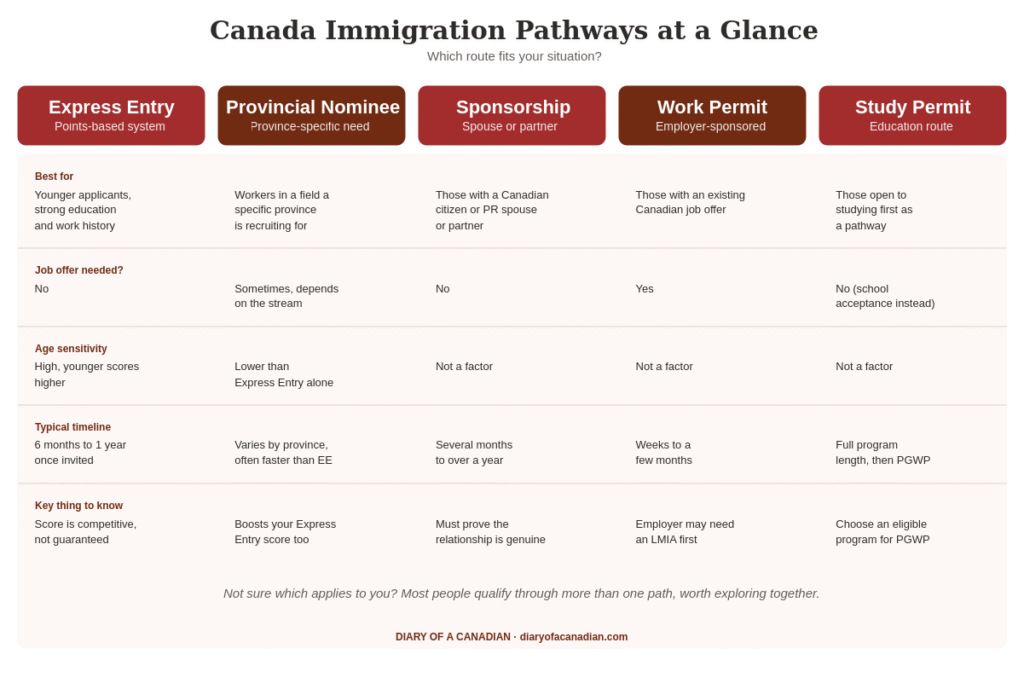
There is no single “moving to Canada” application. Which path is realistically open to you depends on your age, education, work experience, language ability, and family situation. Getting this part right matters more than almost anything else in the process, since picking the wrong pathway can cost you months of wasted effort.

Express Entry
Express Entry is Canada’s primary points-based system for skilled workers, covering programs like the Federal Skilled Worker Program, Federal Skilled Trades Program, and Canadian Experience Class. Candidates are scored using the Comprehensive Ranking System, which weighs age, education, work experience, and language proficiency (usually tested through IELTS or CELPIP). Periodically, the government invites the highest-scoring candidates in the pool to apply for permanent residency.
The part that surprises a lot of applicants: age matters a lot in this scoring system. Younger applicants, generally those in their 20s and early 30s, tend to score higher, while applicants over 40 often see their score drop meaningfully even with strong careers and education. This doesn’t mean Express Entry is off the table if you’re older, but it does mean you shouldn’t rely on it as your only option.
Provincial Nominee Programs (PNPs)
Every province except Quebec runs its own nominee program, allowing them to nominate candidates who match their specific labor market needs. If you work in a field a province is actively recruiting for, healthcare and skilled trades come up frequently, a provincial nomination can be significantly faster than waiting in the general Express Entry pool, and a nomination adds a large number of points to your Express Entry score if you’re in both systems.
Each province’s requirements differ, so this is worth researching specifically for wherever you’re actually considering living, rather than assuming one province’s rules apply everywhere.
Spousal or Common-Law Sponsorship
If you have a Canadian citizen or permanent resident spouse or common-law partner, they may be able to sponsor you directly. This process runs on a different timeline than Express Entry and has its own documentation requirements around proving the relationship is genuine. Some applicants are able to work in Canada on an open work permit while their sponsorship application is being processed.
Employer-Sponsored Work Permits
If you already have a job offer from a Canadian employer, they may be able to sponsor a work permit for you, sometimes through a Labour Market Impact Assessment (LMIA) proving no Canadian worker is available for the role, sometimes through an LMIA-exempt category if you qualify (certain trade agreements between the US and Canada create exemptions for specific job categories).
Study Permits
If further education is realistically part of your plans anyway, studying in Canada can be a genuine pathway. Graduates of eligible Canadian programs can often apply for a Post-Graduation Work Permit, which in turn can lead to permanent residency through Canadian Experience Class.
Picking the Right Path for You
A rough way to think about it: if you’re young, highly educated, and in a shortage occupation, Express Entry alone might work. If you’re in a specific in-demand field, look hard at Provincial Nominee Programs. If you have a partner or a job offer already, those pathways often move faster than starting from zero with Express Entry. And if none of the above fit cleanly, studying may be worth genuinely considering rather than dismissing as a “student thing.”
What It Actually Costs to Move
This is where people get caught off guard most often, not because the move is unaffordable, but because the real costs show up in places people don’t anticipate.

Proof of Funds
Most immigration pathways require you to demonstrate a minimum amount of savings to support yourself and any dependents after arrival. This required amount has increased over recent years, so always check the current figure directly on the official IRCC website for your specific household size rather than trusting a number from an older blog post or forum thread.
Your US Credit History Doesn’t Transfer
This is one of the most consistently reported surprises among people who’ve made this move. Your credit score and history in the US simply do not carry over to Canada. Even with excellent US credit, you effectively start from zero, which can make renting an apartment or getting approved for a loan or car financing considerably harder in your first year or two.
A few practical workarounds people commonly use:
- Keep your existing US credit cards and loans open and in good standing even after you move, since you may still need that history if you ever return
- Ask your card issuer whether they offer any cross-border credit transfer option (some, like certain premium cards, allow you to open a Canadian card based on your existing relationship with them)
- Some landlords will accept a US credit report as supplementary information even though they can only formally run a Canadian check, so it doesn’t hurt to offer it
- Expect to build Canadian credit gradually, starting with a low-limit secured or newcomer credit card, using it lightly, and paying it off in full each month. Many people see meaningful improvement within roughly three to six months of consistent use
Cost of Living Varies Enormously by City
Toronto and Vancouver are expensive, broadly comparable to major US coastal cities, while cities like Calgary, Halifax, Winnipeg, and many smaller communities are considerably more affordable, sometimes dramatically so. Salaries also tend to run lower than equivalent roles in the US, so it’s worth researching pay specifically for your role and industry in your target city rather than assuming your current salary translates directly. Some newcomers also report certain everyday costs (like utilities or cell phone plans) being cheaper than what they were paying in parts of the US, even when overall housing costs are higher, so the comparison isn’t always one-directional.
Cross-Border Taxes
You’ll likely still need to file US taxes even after becoming a Canadian tax resident, on top of your new Canadian filing obligations. This area gets complicated quickly: retirement accounts like 401(k)s and Roth IRAs are treated differently across the two countries’ tax systems, and certain Canadian tax-advantaged accounts (like TFSAs) can create unexpected complications for US citizens specifically. This is genuinely one of the few areas where paying for a qualified cross-border accountant, rather than researching it yourself, is worth the cost.
Healthcare: What to Actually Expect
Canadian healthcare is publicly funded, but it isn’t free or immediate the moment you land. Most provinces impose a waiting period, often around three months, before your provincial healthcare coverage begins. Private insurance to cover that gap is genuinely worth budgeting for rather than going without coverage during that window.

The Family Doctor Reality
Once you’re covered, the next adjustment is around access rather than cost. In many provinces, official waitlists for a family doctor can run well over a year. This surprises a lot of people, but it doesn’t mean you’re without care in the meantime.
Walk-in clinics are free (covered by your provincial health card once active) and are connected to the same records system, so your history, referrals, and prescriptions all carry forward even if you see a different doctor each visit. The strategy that seems to work best for a lot of newcomers: register on your province’s official family doctor waitlist, but also proactively call around to local clinics directly and ask if they’re accepting new patients, rather than passively waiting for the registry system alone.
Dental, Pharmacy, and Specialist Care
Basic provincial healthcare typically doesn’t cover dental or prescription medication costs, so factor those into your budget separately, either through a private plan or an employer benefits package once you’re working. For non-urgent specialist care, wait times can be long in some provinces, so if you have an ongoing condition, it’s worth researching typical wait times for that specialty in your specific target province ahead of time.
Logistics Nobody Mentions
Beyond the big-ticket items (immigration, money, healthcare), there’s a layer of everyday practical friction that catches almost everyone off guard.
Phones and Digital Accounts
Most Canadian phone plans require a Canadian ID and a Canadian credit card to sign up, so many newcomers keep their US phone plan running for the first several months rather than switching immediately, sometimes on an affordable North American roaming plan through their existing US carrier. Expect to rebuild a surprising number of digital accounts from scratch too, streaming services, retail accounts, and loyalty programs often don’t transfer across the border and need fresh sign-ups.
Driver’s License and Car Insurance
When you exchange your US driver’s license for a provincial one, you typically have to surrender your US license, and may be issued a temporary paper license while your permanent card is processed. If you’re bringing a car, gathering thorough documentation of your driving history before you leave is genuinely worth the effort, since newcomers without documented history are sometimes treated as first-time drivers for insurance purposes, which can significantly increase your premiums.
Crossing the Border with Your Belongings
When declaring your goods as a new resident, having an itemized list with approximate values makes the process considerably smoother. Rules vary by item type: alcohol needs to be itemized specifically (type, quantity, and alcohol percentage) and typically has duties applied even when most other personal belongings are exempt as a new settler. It’s also worth checking current rules on items like used mattresses, which face restrictions in some provinces.
Settling In: The Cultural Side
On the surface, Canada can feel deceptively similar to the US, similar stores, similar language, similar day-to-day rhythm. That similarity is actually part of what catches people off guard, since the real differences are more subtle than moving somewhere with an obviously distinct culture.
A few things that come up repeatedly in newcomer experiences: communication styles tend to be more indirect in professional and social settings, so direct, blunt American-style communication can sometimes land as more confrontational than intended. Small everyday things (like taking your shoes off at the door, or realizing a flashing blue light on the highway means a snowplow rather than a police car) are minor but genuinely common early “aha” moments.
Canada also isn’t culturally uniform. A move to British Columbia is a very different experience than a move to Ontario or the Maritimes, in climate, cost of living, job market, and social culture. It’s worth researching your specific target region rather than treating “Canada” as one single experience.
Reactions from family and friends back home vary widely too, and tend to shift over time as people adjust to the idea, sometimes becoming more supportive, sometimes staying resistant regardless of how well the move goes.

Realistic Timelines
Timelines vary significantly depending on which immigration pathway applies to you and current processing volumes, but as a general shape: expect the application and approval process itself to take anywhere from several months to well over a year. On top of that official timeline, budget real time for the practical side after you arrive, opening accounts, securing housing, and getting through the healthcare waiting period, before things start to feel genuinely settled. Most newcomers report the first six months to a year as the real adjustment period, even once the paperwork itself is done.
Should You Actually Do This?
It’s worth being honest with yourself here rather than only chasing the appealing parts. Plenty of Americans who’ve made this move are genuinely glad they did, citing healthcare, safety, and overall quality of life as real, tangible improvements. Just as many are candid that the financial trade-offs, lower salaries relative to high housing costs in major cities, were harder to adjust to than expected. Both of these things are frequently true for the same person at once.
The people who tend to feel most confident in their decision, based on the accounts we’ve come across, are the ones who went in with a realistic, specific picture of their target city and situation, rather than an idealized general sense of “Canada is better.”
Frequently Asked Questions
Do I need a job offer before I can move to Canada? Not necessarily. Express Entry and several Provincial Nominee Programs don’t require a job offer, though having one can strengthen your application or open up faster pathways.
How much money do I need saved before moving? This depends on your pathway and household size, and the required minimum has increased in recent years. Always confirm the current figure on the official Government of Canada site before finalizing your budget.
Will my US credit score carry over? No. You’ll need to rebuild credit in Canada from scratch, though there are ways to speed this up, covered in more detail further down this guide.
Is healthcare really free? It’s publicly funded once your provincial coverage begins, but there’s typically a waiting period after you arrive, and dental and prescription costs usually aren’t covered under basic provincial healthcare.
How long does the whole process take? Anywhere from several months to well over a year for the immigration process itself, plus additional time after arrival before things feel settled.
Where to Go From Here
This guide covers a lot of ground, but each section here is really the entry point into a much deeper topic. If you’re seriously considering this move, the next step is getting organized with an actual checklist you can work through, rather than trying to hold all of this in your head.
Get the free US to Canada Moving Checklist. It walks through everything above in practical, actionable detail: the specific steps for proof of funds, how to approach credit and banking, what to do about the healthcare gap, and the logistics nobody mentions until you’re already dealing with them.
And if you’re ready to go even deeper, once you’re on the list you’ll hear about the Complete Guide to Moving to Canada, covering the full immigration pathway breakdown chapter by chapter, a detailed money and cross-border tax chapter, and templates to help you plan the actual move step by step.